SharePoint Adoption Kit – Show Me How Videos

Here is the collection of Show Me How videos from Microsoft for SharePoint 2010. These videos are part of the Microsoft SharePoint Adoption Kit and include some great examples. My favorites are video 1 – phonetic search, video 2 – co-authoring Word documents, video 6 – the Group Work Site and video 9 – workflow and document approval.

Sharepoint Adoption Kit Continue reading “SharePoint Adoption Kit – Show Me How Videos”

Microsoft Sharepoint User Profile Synchronization I – Clearing the Config Cache

While troubleshooting a failed User Profile Synchronization Service, I needed to clear the config cache. The config cache is where config settings are stored locally on the Microsoft SharePoint server, so a SQL call isn’t required. Sometimes these files get corrupted, which happened to me while setting up the User Profile Synchronization Service.

To clear them: Continue reading “Microsoft Sharepoint User Profile Synchronization I – Clearing the Config Cache”

Installing SharePoint 2010 SP1

As Jethro Tull used to sing, ‘Nothing is easy…’. Although installing SP1 for SharePoint 2010 isn’t hard, there are a few extra steps beyond running the .exe for SP1.

If installing SP1 for SharePoint Foundation 2010, then run:

  1. SP1 for SharePoint Foundation 2010
  2. SP1 for SharePoint Foundation 2010 Language Pack (if applicable)
  3. Cumulative Update from June 2011

If installing SP1 for SharePoint Server 2010, then run:

  1. Steps 1 and 2 from above
  2. SP1 for SharePoint Server 2010
  3. SP1 for SharePoint Server 2010 Language Pack (if applicable)
  4. Cumulative Update from June 2011

Finally, after installing SP1 and the Cumulative Update, you must run the SharePoint 2010 Products Configuration Wizard to tell the system it is now SP1.

Site Permissions – Object reference not set to an instance of an object

Recently had a strange experience with a client site. Clicking on Site Permissions caused this error:

“Object reference not set to an instance of an object”

I was also getting an error when backing up thru Central Administration:

“The Default Zone of this Web Application has no associated IIS Web site.”

Somehow the Default Web Site in IIS was being used for SharePoint instead of SharePoint – 80. To fix this:

  1. Unextend all the Web Applications  (do NOT check delete web site for Default Web Site).
  2. Extend SharePoint – 80
    1. Use Port 80
    2. Use standard virtual directory path

SharePoint Designer Workflow – Majority Voting

Recently faced with the challenge of writing a SharePoint Designer workflow that moved a change request thru 6 steps. One of those steps asked 12 team members to vote on the request. As soon as a majority vote was determined, the step could end, and the workflow could continue. This meant not all 12 people needed to vote, the workflow only needed to know that more than 50% of the voters had chosen to approve or reject the request.

By leveraging the Task Customization Tools in SharePoint Designer 2010 and the Task Process Result Data source, here’s how I did it.

  1. Add Start Approval Process action to my workflow.
  2. Click Approval link to view the Approval Task page
  3. Change the name to ‘Majority Voting’
  4. Click on the Change the behavior of a single task link
  5. Scroll down to the When a Task Completes step
  6. At the end of this step add logic to end the Majority Voting task and continue on with the workflow
  7. In the screen shot below I’ve added the few lines required:
    1. Add comment to indicate changes
    2. Insert If any value equals value condition
      1. Click the first value link
        1.  Leverage the Task Process Results Data source for the first value of the condition. This Data source contains great fields for use in this situation.
        2. Select the Percentage of Approved Field from source.
        3. Click OK
        1. Change equals to is greater than
        2. Click the second value link and enter 50
      2. Add a Log to History List action
      3. Add a End Task Process action
      4. Add an Else-If Branch
      5. Add an If any value equals value condition
        1. Leverage the Task Process Result Data source again, this time using Percentage of Rejected field
        2. Change equals to is greater than
        3. Change second value to 50
      6. Add a Log to History List action
      7. Add a End Task Process action
  8. You have finished using the Task Customization Tools, in the breadcrumbs click on Editor to go back to the Editor for the main workflow
  9. Click on these users link
  10. Add the participants
  11. Swith from One at a time (serial) to All at once (parallel)
  12. Add a Title and Instructions
  13. Click OK
  14. The Majority Voting step is done

Identify Worker Process

This post is directly from  Abhijit Jana’s blog

Identify Worker Process in IIS 6.0

• Start > Run > Cmd
• Go To Windows > System32
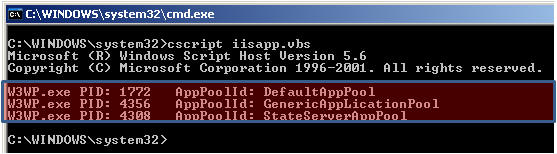
• Run cscript iisapp.vbs
• You will get the list of Running Worker ProcessID and the Application Pool Name.


So, here is your list of all worker process with corresponding application pool name.  From  the Application pool name you can easily identify which worker process is related with your application.

Identify Worker Process in IIS 7.0
From IIS 7.0 you need you to run IIS Command Tool ( appcmd ) .
• Start > Run > Cmd
• Go To Windows > System32 > Inetsrv
• Run appcmd list wp

Solving Some HR Problems – Forms, Forms, Forms

Forms, forms, forms

Would you see value in a forms system that allowed employees, management and HR staff to fill out forms and automatically route those forms for approval based on your business rules?

That same system would allow users to search, retrieve, archive and disposition forms according to your requirements.

Would you see value, if you could have the system without buying any hardware or software?

Chances are you have what you need and may not know it. You see Windows SharePoint Server 3.0 and SharePoint Foundation 2010 are free, they run on Windows Server and provide all the features described above when it comes to forms handling. If your company is using a Microsoft Windows Server you probably own everything you need.

Follow this simple example:

The Quality Manager has hired a new technician, Brenda. She arrives on her first day of work and for whatever reason, the new hire doesn’t receive an ID badge, she has a desk but the phone is disconnected and the computer hasn’t arrived yet. The computer comes the following day, but her email account hasn’t been setup yet.

Safety training is today, but they don’t have room for her in the class because nobody notified the trainer.

Payroll needs to know about the new hire, and Benefits still needs her to make insurance and 401k selections.

Now follow this example:

The Quality Manager that hired Brenda goes to the company intranet, fills out the New Hire form and submits it.

Stacy in HR finds an alert email about the New Hire form for Brenda. She reviews the form by clicking a hyperlink in the message. She likes what she sees, so starts the New Hire automated workflow with a few mouse clicks.

Tom in Security now receives notice Brenda will need a badge for building access. The notice includes the particulars of access like rooms, times and days.

In addition to Security, John and Jeff in IT receive emails indicating Brenda joining the company and needing a phone, a laptop, network folder access, a network login and email account. And she needs access to the APQP system.

Chris in Payroll and Jenny in Benefits are notified as well so Brenda will have a paycheck on her first payday. And Jenny knows to schedule her for an insurance and 401k meeting.

That is pretty good for one simple change in the Quality Managers behavior; using the New Hire form on the company intranet.

One last thing, Jeff in IT planned to build her laptop but was interrupted by a server failure. Fixing that took all day and some of the evening. He has completely forgotten about Brenda’s laptop and the email about Brenda is now buried in his inbox by 20 other emails. Fortunately he received an  automatic reminder the next day about the laptop. He remembers Brenda and builds her laptop. We all forget, but getting that reminder helps us succeed anyway.

Oh, and yes, the trainer was notified about the new hire needing to attend the safety class.

Yeah but we already…

Maybe you are thinking, “Yeah, but we already…”

…email a Word document around

Simple, there is one source of truth. The New Hire form submitted by the Quality Manager is stored in one controlled location. There is a change history associated with the form, so it is simple to see who changed the document and how. It also cuts down on storage in your Inbox because it is not stored there, but it is one hyperlink click in your email away.

Reduced Inbox storage means, reduced calls to IT asking them to increase your mailbox storage limit.

…have a network folder

You cannot filter, sort and search a network folder for New Hire forms for the Sandusky and Tampa locations for the Finance and Engineering departments. You cannot restore the New Hire form back to what it looked like before Security changed it. SharePoint allows for change control and any fields in the form can be used for searching, filtering and sorting. So if you want to see new hires in your Sandusky and Tampa locations for the Finance and Engineering departments, it’s easier than filtering and sorting data in Excel.

Dream

Dream about the time saved in your department and in the company.

Consider Brenda, Quality Technician: 8+ hours lost because she doesn’t have a computer, building access, email and a phone. Consider the Quality Manager: 1 hour lost chasing her computer, phone, etc. Consider HR: 1 hour lost ensuring Payroll, Benefits, Security and Safety have welcomed Brenda with a paycheck, insurance, a badge and training.

Consider the time savings if you are using paper forms and signatures. Nobody walking a form around for approvals, no inter-office mail and no calling around to find out where the form is in the approval process.

Then consider all the Brendas every year.

Then consider these other forms:

  • time off requests
  • performance reviews
  • position changes
  • salary changes
  • payroll fixes
  • payroll changes
  • discipline
  • terminations
  • job applications

Building a New Hire form and workflow is only a couple of days of work, depending on requirements for the form and the approval process. The time spent building the form and workflow pays for itself very quickly.

Summary

I’m passionate about SharePoint and how it can help companies. My job is to help you improve your business and hopefully by writing this article I’ve given you some ideas on how to do that.

If you have questions or want more information, phone calls and emails are always free.

 

Calculated Column and Date Time Formats

After much searching I found some formats that work, but have not found a good reference document.

To modify the format of a date or time, convert the column to text and apply these formats as needed.


Month m, mm
Day d, dd
Year yy, yyyy
Hour h, hh
Minute m, mm
Second s, ss
AM/PM AM/PM

Of course you need to go into SharePoint Designer and do a nowrap=”true” on the <td> if the date renders on 2 lines.